Looking back at 2023 it was filled with a lot of research getting hands on with gen AI initiatives. I am a firm believer in going ‘all in’ if you want to learn something and get the experience by ‘hands on’ doing. Being surrounded by enthusiastic, smart and incredibly clever people made this an enjoyable experience.
Some key highlights, in no particular order.
I got involved with the Aotearoa AI Forum and was a contributing member in key initiatives on AI. One project was the creation of AI Governance tool kit. This project saw a diverse group of people who were passionate about the topic get together and collaborate on creating three toolkits for AI governance. The toolkits were launched in September 2023 at the Aotearoa AI Summit in Auckland. The groups’ focus was to make this accessible for any organisation based on their level of need, so they didn’t have to start with a blank sheet of paper. Go check out the Toolkits here, and if you want to contribute get in touch via the AI forum. Thanks to Gabriela Mazorra for leading the charge and Colby Raley for sound advice!
https://aigovernance.nz/toolkits
I did an opinion piece based on my work in the Education sector – and Peter Griffin kindly put my words into this article, highlighting the potential and impact of AI in the education sector and why NZ needs to embrace gen AI for equitable education with the policies and guidelines in place for innovation.
https://aigovernance.nz/articles/education-is-on-the-frontline-of-the-ai-revolution
Access to equitable education in NZ is a key interest for me as we look at what is being applied elsewhere in the world and closer to NZ in Australia as gen AI is being used to provide capability and access to all learners.
A quote that stood out for me based on what the Yale School of Management are doing as they prepare students for a Workplace Transformed by AI.
“ Our students graduating this year are stepping into a race that has just begun, every company on the planet is thinking about how to use LLMs to better serve their customers and get a leg up on competitors.”
https://som.yale.edu/story/2024/new-course-prepares-students-workplace-transformed-ai
In terms of the community and engagement taking the opportunity to connect with others was a personal highlight.
Kicking off Wellington gen AI Meetup Group (with Colby Raley & Cushla McCarthny ), as a way to connect and share what is happening in this domain. We had two successful sessions, and we are planning a few more for 2024. Join and come along to the next event in March. https://www.meetup.com/wellington-gen-ai-meetup/
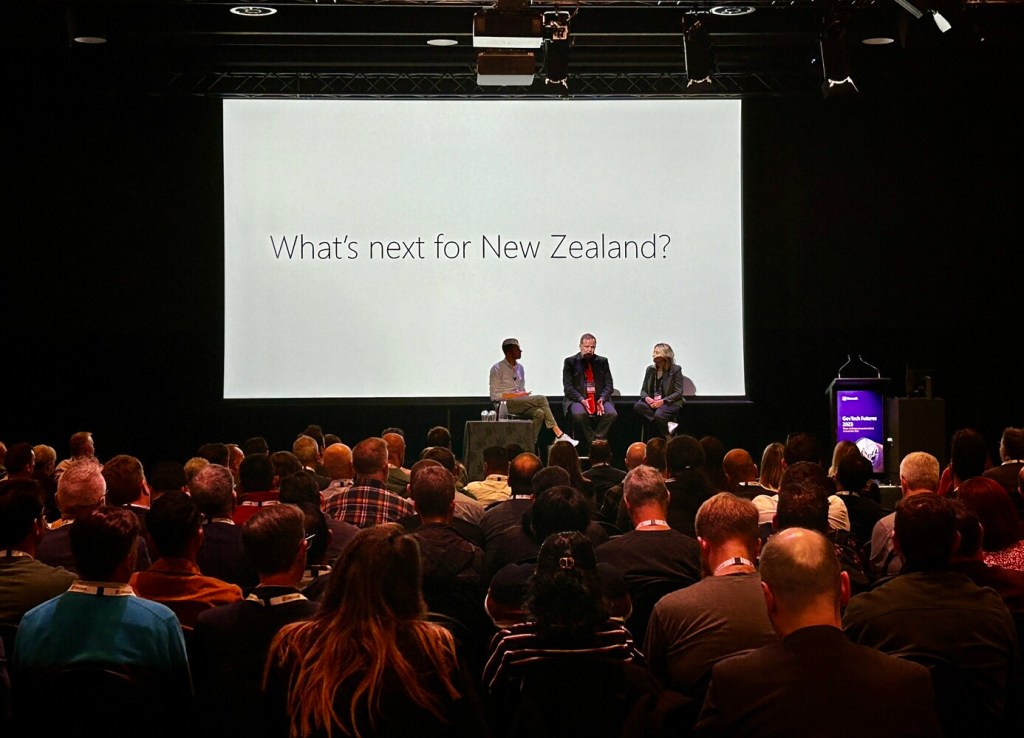
The Microsoft GovTech Futures event in Wellington in November 2023, attracted a range of customers from public sector. My talk with Jimmy Kerr and Bevan Sinclair focused on the NZ North Azure cloud region and the opportunity to address some of the complex and urgent issues that NZ faces, such as climate change, health care, education, and social equity. The highlight of the event was the keynote by Maciej Surowiec which opened up a discussion on how New Zealand is uniquely positioned to capitalise on the AI opportunity and drive positive social and economic outcomes. The keynote was followed by a panel discussion on “What’s Next for New Zealand?“, where the panel shared their insights and perspectives on the innovation opportunities that NZ has. Key takeaway, A robust digital economy can enable solve problems, improve efficiency and productivity, and deliver better services and outcomes for everyone.

And to kick off 2024, the highlight so far was the Microsoft AI Tour in Sydney in February. The attendance of over 3000 people proved that there is tremendous interest in what AI technology can deliver today and to the future. Steven Worrall and Scott Guthrie ‘s keynote was a highlight along with early adopter case studies across a range of industries. The chance to connect with customers and hear first hand on what they are planning gave valuable insight. Also got a chance to (re)connect with new and old friends and colleagues.
Focusing on Australia, the NSW Department of Education’s early learnings and collaboration with Microsoft lead to the DoE launching a generative-AI ‘assistant’ for students and teachers. The solution purpose built for safe and responsible use of gen AI in schools. The aim of the solution is to help teachers personalise and deepen learning for students, teach AI literacy skills and help support teachers with tasks such as developing lesson plans, assessment marking rubrics, and other content used in education. The gen AI app itself has been designed to interact with students in a way that encourages critical thinking, reasoning skills and creativity rather than providing complete answers.
The project named “NSWEduChat” is being trialled in 16 schools with 16,000 students.
Link to the story/video here:
Media release:
The rapid advancement of gen AI also brings into focus challenges across the board. Some of these are micro and some are broader macro challenges. I won’t go into the details here but suffice to say that there are many people and organisations who have voiced their concerns alongside the optimism. Time will tell how these things will work out, and as with any tech the more you learn and understand it the better you will be at adopting it and using it for solving problems.
Some research-based info:
- From the World Economic Forum, almost 25% of jobs are expected to be “disrupted” by AI over the next five years. WEF indicates that there will be 14 million fewer overall jobs in 2028.
- AI is expected to create 133 million new jobs by 2030, according to McKinsey. Although there’s narrative on the negative impact AI may have on jobs, some sources predict that millions of new roles will be created as they’re gradually incorporated into existing businesses or converged.
- 65% of companies are using AI internally (or have been), while 74% are testing it, according to Deloitte. Most companies have officially jumped on the AI bandwagon. A good proportion of companies are using AI internally and an even larger percentage claiming to be “testing” the technology.
- 6% of businesses cite “inaccuracy” as the greatest risk when using AI enhanced solutions, according to McKinsey. However, cybersecurity, privacy and IP theft rank highly as well.
 chandima.net